


|
|
|---|


Monday, April 6, 2009


The 2008 Chevrolet Tahoe Hybrid – the first General Motors vehicle to use the company’s all-new two-mode hybrid system – has been named Green Car Journal’s 2008 Green Car of the Year®. The award was presented at a press conference this morning at the Los Angeles Auto Show.
“This is a milestone in many respects,” says Green Car Journal editor and publisher Ron Cogan. “People don’t think ‘green’ when SUVs are concerned, and for generally good reason since SUVs often get poor fuel economy compared to most other vehicles. Chevrolet’s Tahoe Hybrid changes this dynamic with a fuel efficiency improvement of up to 30 percent compared to similar vehicles equipped with a standard V-8.”
According to the EPA’s 2008 estimated fuel economy ratings, Chevrolet’s achievement is even more apparent during city driving where a large percentage of SUVs spend their time every day. In this environment, the 6.0-liter two-mode hybrid Tahoe achieves 50 percent better fuel economy than a Tahoe powered by a standard 5.3-liter V-8. What’s equally eye-opening is that the Tahoe’s 21 mpg city fuel efficiency rating is the same as that of the city EPA rating for the four-cylinder Toyota Camry sedan.
"We're thrilled to receive this recognition from Green Car Journal for our Chevrolet Tahoe Hybrid,” says Ed Peper, Chevrolet general manager. “We've felt that the Tahoe Hybrid represents the best of both worlds – the great utility you'd expect from a Tahoe with fuel economy on par with today's mid-size cars. It's satisfying to receive this validation from such an authority on environmentally-friendly vehicles."
The Chevrolet Tahoe Hybrid was selected in a majority vote by a jury of high-profile environmental and industry leaders, along with four Green Car Journal editors. Invited jurors this year included Carroll Shelby, Jay Leno, Carl Pope (Sierra Club), Christopher Flavin (Worldwatch Institute), Jonathan Lash (World Resources Institute), and Jean-Michel Cousteau (Ocean Futures Society).
"GM promised they would use hybrid technology, and use it where it would make the most difference – on their biggest vehicles. They have delivered with the Chevy Tahoe,” says Carl Pope, executive director of the Sierra Club, pointing out that this vehicle ends the argument that efficiency and vehicle choice are incompatible. He adds that automakers should now make their entire fleets fuel efficient as fast as they can retool.
The Tahoe Hybrid is the industry’s first application of hybrid technology in a full-size SUV. While a few vehicles with V-6 and V-8 engines are offered with hybrid options, most hybrid technology is incorporated into mid-size or smaller vehicles with four-cylinder engines because this is where big fuel economy gains are most readily achieved. It’s a different challenge to achieve meaningful mpg increases on large vehicles of greater weight where substantial cargo hauling and towing may be needed, and larger engines are required for the job. For instance, the Tahoe Hybrid features seating for up to eight passengers, a 60 cubic foot cargo volume with the second and third row seats folded, the ability to carry up to 1400 pounds of cargo, and a tow rating of up to 6,200 pounds.
“The importance of GM’s accomplishment can’t be overstated,” says Cogan. “For years, consumers have been buying SUVs in increasing numbers because of their functionality, making them the number one class of vehicle on the market. The problem has been obvious: With larger vehicles generally comes poorer fuel economy because of greater size and curb weight. An ‘equalizer’ has been needed…and the two-mode hybrid system in the Tahoe is clearly that equalizer.”
Along with the Tahoe Hybrid, the jury considered 2008 Green Car of the Year nominees including the Chevrolet Malibu Hybrid, Mazda Tribute Hybrid, Nissan Altima Hybrid, and the Saturn Aura Hybrid. Dozens of 2008 model year vehicles using all technologies and fuels were considered by the Green Car Journal staff in narrowing down the field to five nominees.
Along with their considerable achievements in raising the bar in environmental performance, each of those making the final cut had to meet the requirement of being on sale and widely available to the public by Jan. 1, 2008. “Newness” was also a factor in the nomination process, with nominees ideally in the earlier phases of their production cycle rather than near the end. Other factors that weigh in on the decision making include production volume and the likelihood of a candidate vehicle’s environmentally-focused technologies leading to further implementation in other vehicles.
source 2008 Chevrolet Tahoe Hybrid

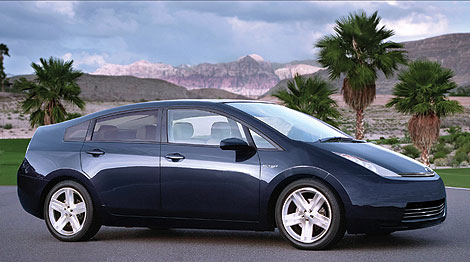

June 7, 2007 - Toyota Motor Sales (TMS), U.S.A., Inc., announced the one-millionth hybrid sale today by parent company, Toyota Motor Corporation. Of the one million hybrid sales worldwide, more than half have been sold in the United States — 541,210 units from 2000 through April 2007.
June 7, 2007 - Toyota Motor Sales (TMS), U.S.A., Inc., announced the one-millionth hybrid sale today by parent company, Toyota Motor Corporation. Of the one million hybrid sales worldwide, more than half have been sold in the United States — 541,210 units from 2000 through April 2007.
“The cost benefit of hybrids is becoming more apparent with climbing gas prices,” said Jim Lentz, TMS executive vice president. “We anticipate combined sales of Toyota and Lexus hybrids of a quarter million units in the U.S. during calendar year 2007.”
Despite earlier concerns that decreased tax credits from the IRS would dampen hybrid demand, Toyota continues to post record hybrid sales. Calendar-year-to-date hybrid sales for TMS totaled 119,154 units, an increase of 75 percent over the same period last year.
In May, TMS posted sales of 36,101 hybrid vehicles, up 102 percent over last May. Toyota Division posted sales of 34,174 hybrids, up 121 percent over the same period last year. Lexus Division posted sales of 1,927 hybrids.
As consumers begin the summer driving season, the broad benefits of hybrid technology reveal discernible cost-savings with strong sales of Toyota Camry Hybrid and Toyota Prius.
Aside from the gas-savings to hybrid owners, the significant reduction in tailpipe emissions, as well as the reduction in foreign oil dependence, has been a factor among many buyers who say they are concerned about the environment. According to a recent study by the National Renewable Energy Laboratory (NREL), hybrid vehicles have saved close to 215 million gallons, or 5.1 million barrels, of fuel in the U.S. since their introduction in 1999. As the market share leader in the hybrid segment, Toyota accounted for 66 percent of all hybrids sold in America during that period.
Additionally, Toyota has calculated that global sales of hybrid vehicles have greatly contributed to reductions in CO2 emissions. Since the introduction of Toyota’s first hybrid in 1997, approximately 3.5 million fewer tons of CO2 were emitted when comparing emissions from gas-powered vehicles to hybrids of the same class.
Also significant to buyers who may base their next purchase on environmental priorities are the results of recent lifecycle assessment studies of hybrid vehicles. A variety of studies, including one from the Argonne National Laboratory, have concluded that the total lifetime energy use of hybrid vehicles—from development, through production, through on-highway use, to end-of-life recycling and landfill—is significantly lower than conventional vehicles.
Prius was launched in the Japan domestic market in 1997, and in the U.S. market as a 2001-model in 2000. In 2005, the Highlander Hybrid SUV debuted as a model year 2006. For the first time, the Toyota Camry added a hybrid option for model year 2007.
In 2005 Lexus entered the hybrid fold with the launch of the world’s first luxury hybrid, the RX 400h luxury sport utility vehicle. Powered by its Lexus Hybrid Drive system, the RX 400h is equipped with a 3.3-liter V6 and two electric motor generators, delivering an impressive 268 total system horsepower while rated an EPA estimate of 32 miles-per-gallon during city driving. The new hybrid luxury SUV has proved popular with environmentally-conscious luxury buyers as the RX 400h has made up nearly 20 percent of all RX sales since it launched.
Lexus continued its venture into hybrids in 2006 with the launch of the GS 450h performance luxury sedan. The GS450h gave further proof that hybrid technology could be used in many different types of vehicles.
The Lexus commitment to hybrid technology continues with the launch of the all-new 2008 LS 600h L premium luxury hybrid sedan when it goes on sale this summer.
Article by. Joel in http://www.thecarblog.com/
Thursday, April 2, 2009
Jakarta - Cars attract Arina Minister of Industry Fahmi Idris. Fahmi also menjajal akan test drive a car or mini Semarang from this.
According to the plan the Minister of Industry Fahmi Idris akan visit to Semarang on Friday 3 March 2009 to see the micro car Arina.
"Menperin also try akan Arina 150 cc car," said the Head of Laboratory Design Appropriate Use of Technology Mechanical Engineering Department of the State University of Semarang, car creator Arina, Widya Aryadi to detikOto, Thursday (2/4/2009) the night.
Fahmi Idris visit to Semarang in the socialization Exhibition Production Indonesia (PPI), which will be held at the Jakarta International Expo on 13-17 May 2009.According to the plan the Minister of Industry Fahmi Idris akan visit to Semarang on Friday 3 March 2009 to see the micro car Arina.
"Menperin also try akan Arina 150 cc car," said the Head of Laboratory Design Appropriate Use of Technology Mechanical Engineering Department of the State University of Semarang, car creator Arina, Widya Aryadi to detikOto, Thursday (2/4/2009) the night.
According to Widya, lawatan Menperin to precisely in Semarang Hotel Patra Jasa Semarang Jalan Sisingamangaraja simultaneously to encourage local automotive industry in Semarang participate showcase the results of its production on the micro car Arina PPI later.
"Hopefully, with the arrival Menperin, the local automotive industry in Semarang at this time can help to absorb labor from the local automotive component industry and the body of a car industry in the country," said Widya.
Arina car designed for 4 passengers, while the engine is available in Arina this engine is quite economical in its use, ie, 1 liter to 40 km and get power to 10.5 hp with a speed of 70 km per hour to 150 c engine

Subscribe to:
Posts (Atom)


